
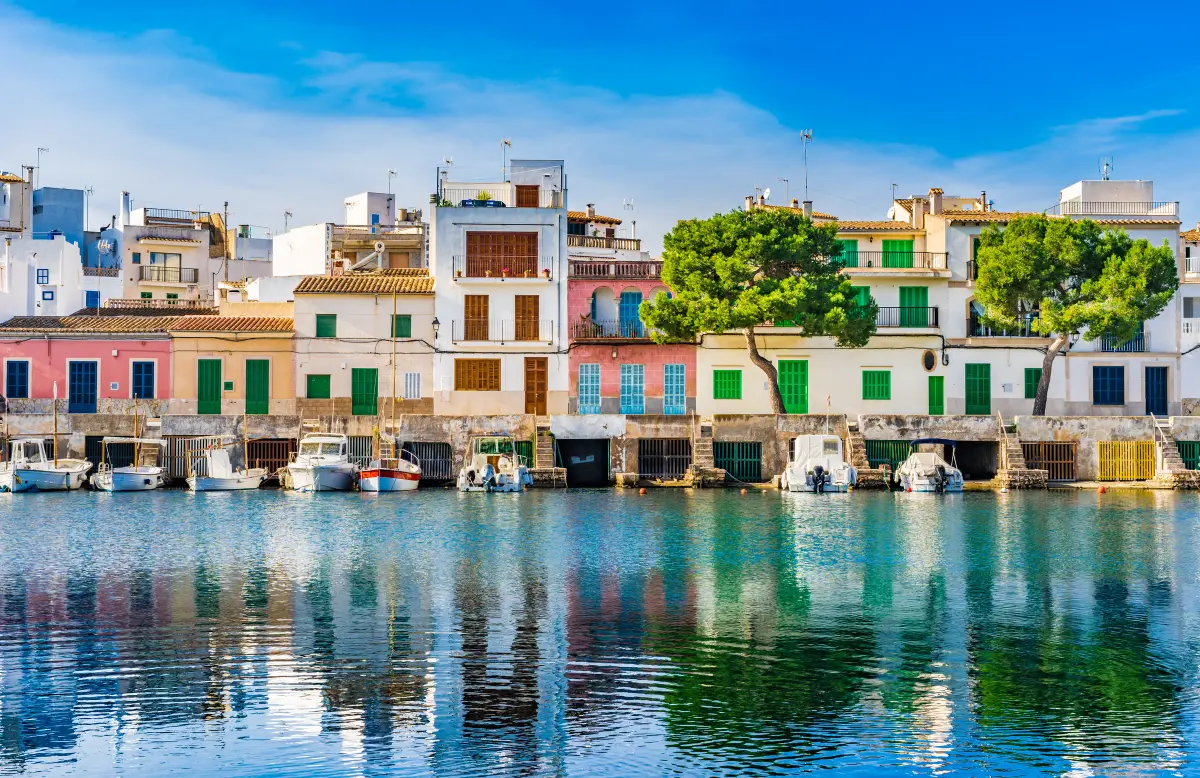
Portocolom is a village, a harbour and a holiday resort all at once. People live here year-round, but there are also many second homes and holiday lets, and it shows: in summer the town is full, in winter it becomes quiet. This guide brings together the practical side for anyone who lives here or stays for long periods.
The town in figures
Portocolom had 4,588 registered residents on 1 January 2023, according to the municipal register published by Spain’s statistics office (INE). It is the second-largest settlement in the municipality of Felanitx, which had 18,886 inhabitants in total:
| Settlement | Residents (2023) |
|---|---|
| Felanitx | 10,149 |
| Portocolom | 4,588 |
| S’Horta | 545 |
| Cas Concos | 439 |
| Cala Ferrera | 231 |
| Cala Serena | 149 |
Portocolom’s registered population has been fairly stable in recent years: 4,396 in 2010, 4,246 in 2015, 4,526 in 2020 and 4,588 in 2023.
These are figures for registered residents. In summer, with second homes and holiday lets, there are far more people in town; there is no official figure for the seasonal population.
Paperwork: everything goes through Felanitx
Portocolom isn’t a municipality in its own right: it belongs to Felanitx, about 11 km away. Registering as a resident (empadronamiento), local taxes, building permits and other council business are handled by the Ajuntament de Felanitx. Its website shows what can be done online and where you need to go in person.
The official languages in Mallorca are Catalan and Spanish. Council documents are usually in Catalan.
Moving to Portocolom
If you’re coming from another EU country to stay, these are the usual steps. The details depend on whether you work, draw a pension or live on your own means, so check them for your own case.
- Padrón. You register on the municipal roll (empadronamiento) at the Ajuntament de Felanitx. Other procedures will ask for the certificate later.
- EU registration certificate. To live in Spain for more than three months you must register in the Central Register of Foreign Nationals. You apply with form EX-18 and fee 790, code 012, at the Policía Nacional, by appointment. You choose the office when you book (mallorca.com). The certificate carries your NIE, the foreigner’s identity number you’ll need for almost everything: banks, contracts, taxes.
- Health card. If you work in Spain you get public healthcare through Social Security; pensioners from another EU country usually do so with the S1 form from their home country. With that, you apply for the IB-Salut card at the health centre. The European Health Insurance Card is for temporary stays, not for living here.
- Tax. As a general rule, anyone who spends more than 183 days a year in Spain is tax resident here and pays Spanish tax on their worldwide income (administracion.gob.es). Having a residence certificate is not the same as being tax resident; for your own situation, ask an adviser.
UK citizens and other non-EU nationals. Since Brexit, British citizens are no longer covered by EU free movement. Living here means getting a visa or residence permit first, applied for through the Spanish consulate in your home country.
Day to day
For everyday needs you don’t have to leave town: there are supermarkets, cash machines, a post office, a petrol station, a pharmacy and a library — see basic services. On Tuesday and Saturday mornings there’s a market by the harbour.
For bigger shopping trips, banking or specialist shops, most people go to Felanitx or Manacor. Plumbers, electricians, garages and other trades are in the business directory.
Healthcare
Portocolom has a public health centre (UBS) open weekday mornings; outside those hours, urgent care is in Felanitx and the local hospital is in Manacor. Full details in health and emergencies.
To use the public health system as a resident you need a health card (tarjeta sanitaria) from the Balearic Health Service.
With private health insurance
- Hospital Parque Llevant, Porto Cristo (Carrer de l’Escamarlà 6, about 18 km away). The area’s main private hospital, open 24 hours a day, all year. It has:
- 24-hour A&E, with a separate children’s area, lab tests, radiology and ICU back-up.
- Specialties: gastroenterology, cardiology, general surgery, trauma and orthopaedic surgery, a spine unit, plastic surgery, dermatology, endocrinology, gynaecology and obstetrics, internal medicine, ENT, urology, aesthetic medicine and a dialysis unit.
- Diagnostics: CT, MRI, ultrasound, mammography, bone densitometry and dental panoramic X-rays.
- Care after road and sports accidents.
- Phone: 971 82 24 00 · hospital website.
- Policlínica Parque Llevant, Felanitx (Passeig de n’Ernest Mestre 36). A smaller centre run by the same group, with no A&E or inpatient beds, offering weekday morning and afternoon appointments: general practice, lab tests, check-ups, gynaecology, dermatology, ophthalmology, trauma, ENT, podiatry, psychology, physiotherapy and aesthetic medicine. Phone: 971 58 22 33.
Before you go, check with your insurer which centres and services your policy covers.
Getting around
You can live here without a car, but with less flexibility. TIB bus 512 links Portocolom with Felanitx several times a day and runs a direct early-morning service to Palma on weekdays; timetables are in the bus article. There are taxis in town.
By car, Palma and the airport are about an hour away. That’s a long daily commute; many residents work locally or remotely. If you drive an electric car, there are public charging points in town.
Summer and winter
From June to September the population multiplies: more traffic, harder parking near the harbour and crowded beaches, especially Cala Marçal. In winter some restaurants and shops close or cut their hours, and the seasonal bus routes stop running. For year-round residents, that quiet is part of the appeal.
The weather, with an hourly forecast for the harbour, is on the Portocolom weather page.
Houses left empty for months
If your home stands empty over winter, plan for damp, pool and garden upkeep and regular checks. The business directory lists home-maintenance services in Portocolom and the surrounding area.
Photo credits
- Header photo: Shutterstock · licensed image
