
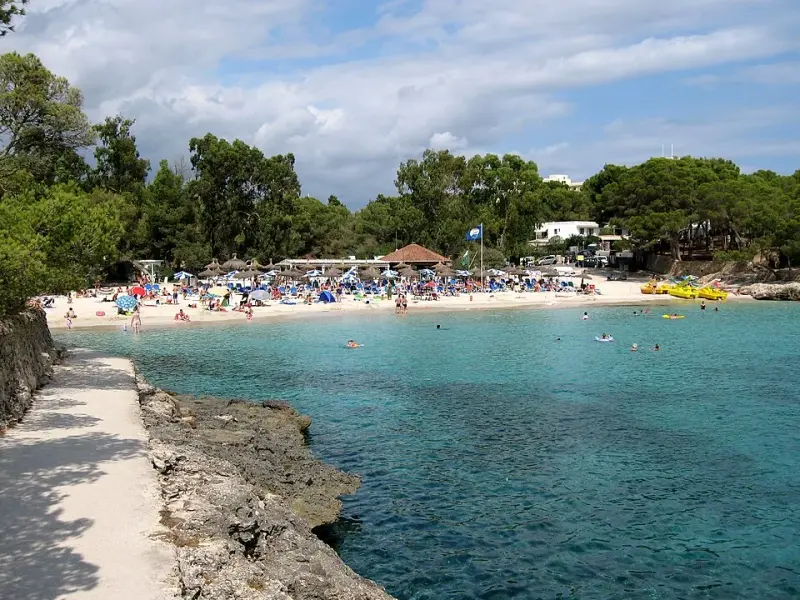
Cala Mondragó is an inlet on the coast of Santanyí, inside Mondragó Nature Park and about 15 km from Portocolom by road (around 20 minutes’ drive). It has two sandy beaches linked by a path along the shore: ses Fonts de n’Alís, which most people simply call Cala Mondragó, and the slightly larger s’Amarador. Both have a Blue Flag in 2026 (PortsIB). Each beach has its own public car park, which charges in summer and is free out of season.
Getting there from Portocolom
By car
Take the Ma-4012 to S’Horta and carry on towards Portopetro; from there the road to Cala Mondragó is signposted. There are two car parks, one for each beach:
- Ses Fonts de n’Alís: next to the park’s information centre. From here, the viewpoint trail leads through the woods to the beach in about 15 minutes (640 m), according to the nature park.
- S’Amarador: at the end of its own access road, about 500 metres from that beach.
In season the car parks are run by a company contracted by the park, which charges for parking; out of season they’re free (Balearic Government). On busy days they fill up early.
Without a car
In season you need two TIB buses. Line 428 runs from Portocolom to Cala d’Or, where you change to the 521, which goes to Cala Mondragó via Portopetro. The 521 ends at the Cala Mondragó stop, right by ses Fonts de n’Alís. Both lines are seasonal and their timetables change every year: check tib.org and our guide to the bus in Portocolom. Outside summer, a taxi is the only option.
The two beaches
Ses Fonts de n’Alís is about 75 metres long and 60 metres wide. The sand is fine and the water deepens gently, with a long stretch of sandy bottom in the middle; at the edges there are rocks and seagrass. It has the most facilities: in season there’s a lifeguard, sunbeds and parasols, pedalos, showers, toilets and a restaurant on the sand itself (mallorca.com). The Balearic beach catalogue lists it as accessible.
S’Amarador is the largest beach in the park, about 145 metres long and 50 wide. It has fewer facilities, and behind it are dunes and a small wetland where the stream meets the sea. The dunes are protected, so cross them only on the paths.
A trail along the coastal rocks links the two, with views over both coves. The beach catalogue rates both as busy in high season.
The nature park
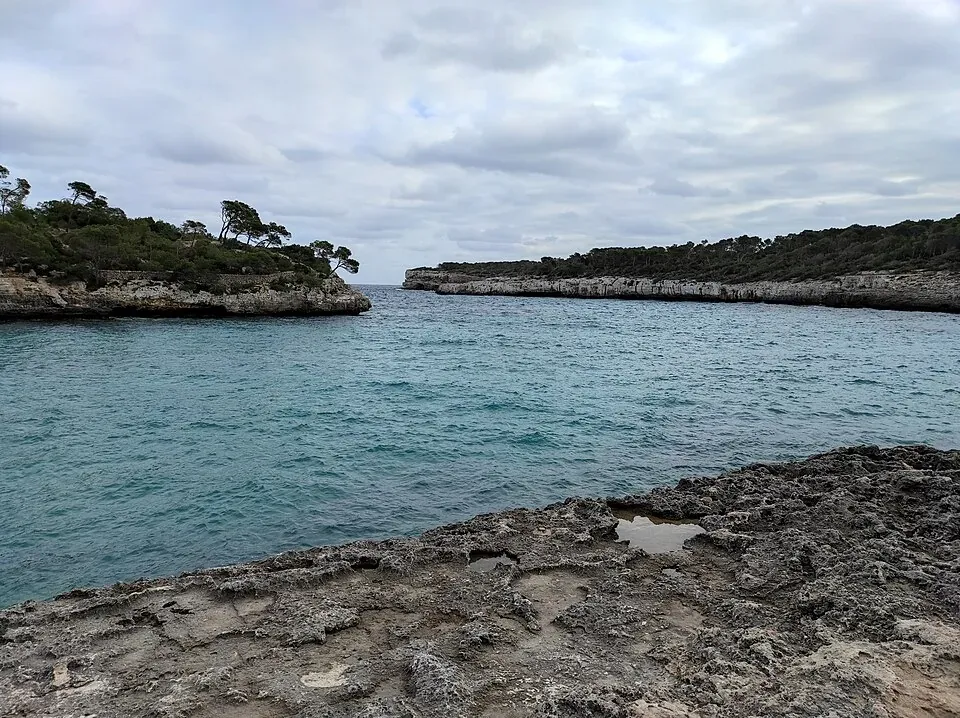
Mondragó was declared a nature park in 1992. It takes in pine woods, scrub, cliffs, caves, farmland and wetlands along the streams. The park has released Hermann’s tortoises to help the species recover. Five short trails are signposted; the longest, around s’Amarador, is 1,100 metres and takes half an hour.
The information centre by the ses Fonts de n’Alís car park opens daily from 9 am to 4 pm, except some public holidays (tel. 971 17 65 02). As a protected area, the park has its own rules, which you’ll find on the park’s website.
Before you go
- The cove is open to easterly and south-easterly winds, which can push swell into it. Check the weather before setting off.
- In summer, arrive early if you’re driving, as the car park fills up.
- Closer to Portocolom there are beaches with free parking: compare them in the beach guide.
Photo credits
- Header photo: Olaf Tausch, Wikimedia Commons · CC BY 3.0 · adapted by Portocolom.online
- The mouth of Cala Mondragó: AlbertoDV, Wikimedia Commons · CC0


